

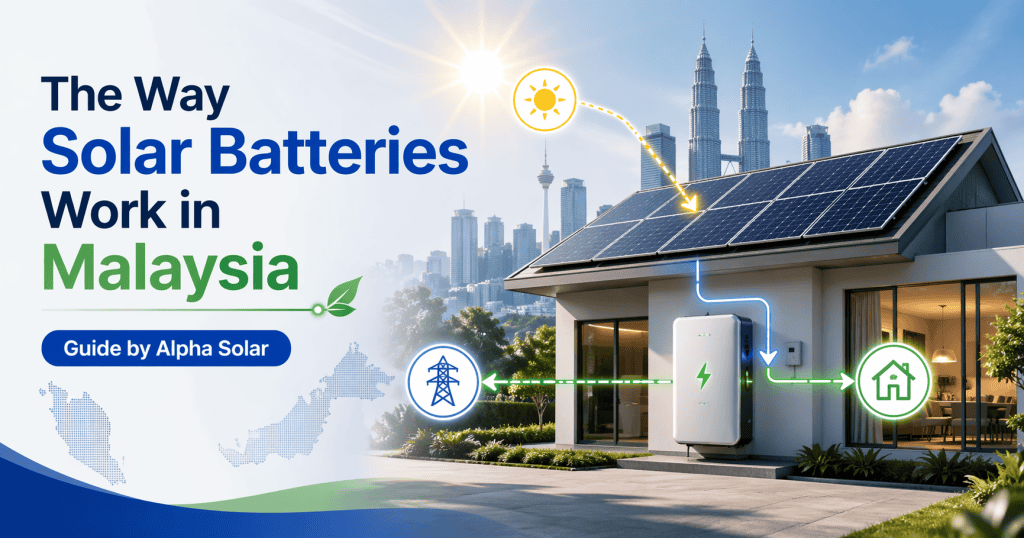
For years, the conversation around solar energy in Malaysia was mostly about panels. You would install the blue or black rectangles on your roof, connect them to the grid, and watch your Tenaga Nasional Berhad (TNB) bill drop. This was largely thanks to the Net Energy Metering (NEM) scheme. Under NEM, the grid acted like a giant, virtual battery. You sent your excess power to TNB during the day and took it back at night.
However, as we move through 2026, the landscape has changed. With the introduction of the Solar ATAP (Solar Accelerated Transition Action Programme), the rules for how we use solar energy have shifted. The focus is no longer just on generating power; it is about storing it.
At Alpha Solar, we have seen a massive surge in interest regarding solar battery storage in Malaysia. Homeowners are realizing that to truly maximize their investment, they need to own their energy. In this guide, we will break down exactly how solar batteries work in our local context and why they have become a must-have for the modern Malaysian home.
The Basic Mechanics: How a Solar Battery Functions
To understand how a solar battery works, you should think of your home as a mini-utility company. Your solar system is used or lost during the day without a battery.
1. Generation and Immediate Use
Your solar panels catch the sunlight during the day and convert it to DC electricity. This is then converted to AC electricity to run your home in your inverter. When you have your air conditioning running in a house at 2 pm, that power is bypassed directly to the unit.
2. Charging the Reservoir
In a system with solar battery storage, the excess energy, which is the power your house is not using while you are at work, does not just go back to the TNB grid immediately. Instead, the hybrid inverter directs that electricity into your battery bank. Think of it like a rainwater harvesting system. Instead of letting the rain run into the street drains, you are filling up a tank for later use.
3. Discharging at Night
This is where the magic happens for Malaysian homeowners. When the sun sets over the Titiwangsa Range and your panels stop producing, your home does not immediately start pulling power from the grid. Instead, the battery kicks in. It provides the stored energy to run your lights, televisions, and fans throughout the evening.
Why the Monthly Reset Changed Everything in 2026
The biggest reason why solar battery storage in Malaysia has become a trending topic is the shift in government policy. Under the old NEM 3.0 rules, you could carry forward your excess credits for months. If you generated a lot of power in July, you could use those credits to offset a high bill in December.
Under the new Solar ATAP regulations, those credits now reset every month. If you produce 500 units of excess energy but only use 300 units of grid power that month, the remaining 200 units essentially vanish at the end of the billing cycle. You do not get paid cash for them, and you cannot roll them over.
This is why we at Alpha Solar now recommend batteries to almost every client in areas like Petaling Jaya and Shah Alam. A battery allows you to keep those 200 units of extra power for yourself. By storing it, you ensure that zero percent of your solar generation goes to waste.
The Alpha Solar Perspective: A Real-World Scenario
Let us look at a story from one of our clients in Kota Kemuning. This family had a 10kWp solar system but no battery. During the day, the house was empty because the parents were at work and the kids were at school. Their panels were producing massive amounts of energy that were sent back to the grid.
However, their biggest electricity usage happened between 7 pm and 11 pm when everyone was home, the lights were on, and the air conditioners were cooling the bedrooms. Despite having a large solar system, they were still paying a significant amount to TNB every month because their night-time usage was so high.
We installed a 10kWh Lithium Iron Phosphate (LFP) battery for them. Now, their daytime excess fills the battery. By the time they get home at 6:30 pm, they have a full tank of energy. They now run their home on solar power well into the night. Their TNB bill dropped by an additional 40% after the battery installation because they stopped buying expensive power at night.
Understanding the Technology: LFP vs. Lithium-Ion
If you are looking to understand solar battery storage, you will encounter different technical terms. The most important one to know in 2026 is LFP, which stands for Lithium Iron Phosphate.
In the past, many batteries used the same chemistry as your smartphone. While effective, these can be sensitive to heat. In the Malaysian climate, where humidity is high and ambient temperatures often hover around 32 degrees Celsius, LFP batteries are the superior choice.
At Alpha Solar, we prefer LFP technology because:
- It has a longer lifespan, often lasting 10 to 15 years.
- It is much more stable and less prone to overheating.
- It can be discharged deeper without damaging the cells.
Peak Shaving and the Time of Use Tariff
Another professional insight we often share with our clients relates to the Time of Use (TOU) tariff. TNB has been moving more residential customers toward a system where electricity costs more during peak hours.
By using a solar battery, you can practice something called peak shaving. You use your stored solar energy during the hours when TNB prices are at their highest. If the grid price spikes between 5 pm and 9 pm, your battery ensures you are not paying those premium rates. You are essentially shaving off the most expensive part of your bill.
Maintenance and Longevity in the Tropics
One question we get asked at our offices in the Klang Valley is: will the heat kill my battery?
It is a valid concern. Solar batteries work best in cool, ventilated environments. When Alpha Solar performs an installation, we do not just plug and play. We look for the optimal location in your home, usually a shaded utility area or a ventilated garage.
Modern smart batteries also come with built-in cooling systems and software that manages the temperature. You can monitor all of this through a mobile app. It will show you how much power is in the tank, how much the panels are producing, and even the health of the battery cells.
Is a Solar Battery Right for Your Home?
While we rely on technology, we always tell our clients that a battery is an investment. The upfront cost for solar battery storage in Malaysia can range from RM 15,000 to RM 40,000 depending on the capacity and brand.
You should consider a battery if:
- Your monthly TNB bill is consistently above RM 500.
- You have high electricity usage at night, such as air conditioning or EV charging.
- You live in an area prone to occasional power flickers or outages.
- You want to be protected against the monthly credit reset of the Solar ATAP scheme.
Final Thoughts
The way solar batteries work in Malaysia is simple in theory but powerful in practice. It is about taking the energy the sun gives us for free and making it available whenever we need it, not just when the sun is shining.
As the energy market in Malaysia continues to evolve, being self-sufficient is no longer just a green choice, it is a financially savvy one. Whether you are in Puchong, Cyberjaya, or Kuala Lumpur, the transition to storage is the next logical step in your solar journey.
At Alpha Solar, we are committed to helping you navigate these changes. We believe that every home has the potential to be its own power plant. If you are tired of watching your solar credits expire at the end of the month, it might be time to look into a storage solution that keeps your power where it belongs: in your home.